


Out There: Dispatches from My Personal Wilderness
Less than half a mile into my hike, I confront a broken bridge over the surging Canyon Creek, which today looks more like a raging river. After removing my shoes and tying them to my pack, I wade barefoot into the heavy flow of frigid water. The unexpected heat wave has melted the snowfields and glaciers of these North Cascades peaks and has made fording this waterway a near impossibility. For more than an hour, I attempt to routefind my way through the heavy folds of water that nearly push my feet from under me. If I lose my balance, this fifty-pound pack will make it difficult to keep myself from drowning. I walk back to my car, defeated. My goal today is to visit the site of Gary Snyder’s first fire lookout on Crater Mountain, a trip I’ve planned for years, but every time I attempt it something happens to keep me from visiting this mythic site. At the trunk of my dusty car, I take off my pack and contemplate Snyder’s words: “Some of us have learned much from traveling day after day on foot over snowfields, rockslides, passes, torrents, and valley floor forests, by ‘putting ourselves out there.’. . . For those who would seek directly, by entering the primary temple, the wilderness can be a ferocious teacher.” His words ring true in this moment.
I open the trunk and see a second pair of old shoes that have been sitting there, forgotten, from some unknown time frame. They become an answer. With a newfound determination, I put my pack back on and for the second time hike to the creek. The shoes on my feet allow me to counter the weight of the water. It climbs past my waist as I use every bit of strength to lean into the river, using both walking poles to keep me from falling forward. It’s over in a matter of minutes, and I find myself soaked and covered in forest humus. After rinsing the soil off my clothes and changing to my dry hiking boots, I stow the wet shoes in a hollow stump and hike up to the intersection of the much longer trail.
An hour or so into the main trail, I come across a group of young folks practically running down the path. They are shocked to see that I am alone. I ask them if they came over the pass, and they say they intended to hike up and over it, but the mosquitoes were so bad that they are giving up.
“Where are you going?” a young girl asks me.
“To camp on Crater Mountain.”
Her face conveys shock. “Alone?” she says. “It’s not safe. And you’ll be eaten alive!”
I assure her I’ll be fine and that I do this sort of thing on a regular basis, but her expression is incredulous, even worried.
A few miles uphill I come across trails of trash on the dirt path. I start picking it up, first foil wrappers and plastic baggies, but soon the detritus gets larger and heavier. There are dirty socks and large packages with freeze-dried meals inside. It’s likely that this trash came from the group I just passed, and the thought angers me. Why would anyone come to this wild place and leave their trash to mar it? Because there is so much trash, I tell myself I’ll pick up the larger items on my return, so I don’t have to carry other people’s trash up the mountain and back down again. Swarms of mosquitoes bite my skin, the ninety-degree heat is oppressive, and this steep climb has turned into a muggy bushwhack. I push through overgrown brush and bramble, my skin scratched and torn. Why do I do this to myself? I used to think it was about the summit, about standing on a distant peak as I overlooked ranges of mountains on all sides. Those moments are glorious, but there’s more to my determination to push through this discomfort. To me, these climbs are reminiscent of my life story. So many obstacles have been in my path as I’ve searched for a place to call my own, on my way to an authentic life of self-acceptance and openness.
I’ve written before about how I found myself in this wild place. The books The Dharma Bums and Desolation Angels filled me with daydreams of mountaintops and enlightenment. Kerouac’s words brought this land to life for me and inspired me to see it for myself. But what I didn’t acknowledge at the time was that Kerouac was inspired by his character Japhy Ryder, based on his friend and outdoor mentor Gary Snyder. It was only through my close reading and research of Kerouac’s process that I came to discover that Kerouac wasn’t the dedicated environmentalist and outdoorsman he presented in his books; these passions were instead the ripples spread out from Snyder’s influence on his life. While Kerouac’s time in wild places eventually dwindled and he did not maintain a connection to it, Snyder spent the days of his life heralding the spiritual importance of a deep connection to wildness. At the moment of this writing, Snyder breathes this message still, and at the glorious age of ninety-five he is a steadfast embodiment, for all of us, of a life lived in equilibrium with the land that births us. A decade ago Kerouac brought me into this wilderness. But Gary Snyder taught me how to have a relationship with it. In The Practice of the Wild, he states that “self realization, even enlightenment, is another aspect of our wildness—a bonding of the wild in ourselves to the (wild) process of the universe.”
I make it to the glacial cirque and pristine Crater Lake to set up camp amid newly surging waterfalls. While the creek I had to cross at the start of this hike presented a difficult obstacle, the heat melting these glaciers has presented me with a magical surge of freshwater that falls on three sides of the cirque. The sound is ethereal, reverberating across the expanse. There isn’t another human soul in this region right now. No tents or human sounds of any kind.
Here I am, among many facets, a gay man doing it all on his own. To me, this climb is a metaphor for queer existence in our time. Not only must we discover our identities and find self-reliance, but we must also do so in context with our time and place. We are out route-finding new trails, new ways of being. Often, we are the first ones to embark on a new path. My own path has so often felt isolated. The solitude in this cirque feels oddly comfortable, a home of my own.

A ridge a few hundred feet above the lake is the perfect spot to set up camp. I drop my pack, and the mosquitoes begin biting. In record time I set up my tent and climb inside to find refuge from the hungry teeth of these insects. The sun began its descent hours ago, and here I sit, accosted by swarms of relentless bloodsuckers.
I watch as they strive to get through the mesh fabric under my rainfly. It doesn’t look like I will make it to the summit, but I tell myself that it’s okay—a successful excursion into nature doesn’t require standing on top of a peak. With that surrender, I decide to continue walking in hopes of finding a nice ledge a thousand feet higher on the south ridge of Crater Mountain, halfway from this camp to my original destination. My new goal is to find a ledge where I can eat my dinner and watch the sun set behind the North Cascades ranges. From the moment I exit the tent, the mosquitoes land on me five times faster than I can squash them into bloody marks with my palm.
I’ve searched high and low for like-minded people in society. That search has often yielded scanty results, with few easily identifiable standard-bearers of the openly gay type. Recently in my journeys I found a self identifying queer environmentalist, Robert Moor, and his work struck a chord in me. In Moor’s wandering opus, On Trails—a meditation on what trails mean for humanity—he asks the question, Why do we hike? His proposed answer: “I believe what we hikers are seeking is simplicity—an escape from civilization’s garden of forking paths.” His offering seems legitimate to me. In my years of walking through wilderness, I’ve returned time and time again for the separation it grants from the frenetic obligations of my life. There is so much noise in my daily life, so many options, so many choices with unknown outcomes. It becomes difficult to make decisions. Out here in the wild the noise softens, and I can see through it, down to a more simplified version of the task at hand. Whether that task is the question of how to exist as a gay man, how open to be in my life and career, and how to accept the world as it is at this moment, all the while reaching for and working toward a better world for tomorrow, these topics are not easy to confront. The hard but rewarding hours on trails give me a moment to catch my breath, center myself, and make decisions about my life.
As I reach the west-facing ridgeline I had planned to eat my dinner on, I realize that I might have enough time to scramble to the summit, which is only eight hundred feet higher. I stop to catch my breath and wipe sweat from my brow. The mosquitoes start biting again. So much for stopping for dinner. I’d be the one eaten. I continue upward and make it to a strange maze of boulders that I climb up using my hands and feet. There are painted yellow X’s to guide the scrambling route; a variety of yellow and orange fungus grows on the rock and is brighter than the faded paint. I climb up the wrong route, realize I’m in a precarious position, climb back down to a yellow X, multiple times without success. Daylight drains from the sky. The sun seems to be inches from the horizon. If I don’t find the route soon, I’ll have to turn back.
I’ve been pushing against this climb all day. The hike started with a difficult river crossing. It’s been oppressively hot, the bugs have been murderous, and here I hang from the side of this peak, alone and incapable of summiting. It all feels so pointless. What am I doing here? A faint but cooling alpine wind passes over my skin, and I realize no mosquitoes are biting me at this elevation. I look up, see the next X, and climb toward it. After that one I see the next, and all the remaining X’s until I climb out of the steep cliffs and onto a magnificent meadow that ambles easily toward the summit. I walk the welcoming ridgeline, held aloft in a supreme state of softness. The fading sunlight changes the world’s color to a brilliant amber.
At the highest point I find a steel post that once held the legendary fire lookout. A glint catches my eye. I am standing on shattered and melted fragments of glass. I squat down and pick one up. Its smooth and sharp contours sit lightly in my hand. It must be the glass from the lookout, melted time and time again by lightning strikes from the winter storms that rage against these peaks. I look out to the many-layered mountains that encompass this place and feel at once timeless and firmly grounded to this mortal moment. I can hardly believe I made it to the top. The reward of standing silently in these primordial mountains as the sun sets is nearly unfathomable.
In this deep mountaintop meditation, I ponder Gary Snyder’s words: “The wilderness pilgrim’s step-by-step breath-by-breath walk up a trail, into those snowfields, carrying all on the back, is so ancient a set of gestures as to bring a profound sense of body-mind joy. . . . The point is to make intimate contact with the real world, real self. . . . The wilderness as a temple is only a beginning. . . . The best purpose of such studies and hikes is to be able to come back to the lowlands and see all the land about us, agricultural, suburban, urban, as part of the same territory—never totally ruined, never completely unnatural. It can be restored.”
Robert Moor said, “It may sound strange (even sacrilegious) to some, but in a very real way, wilderness is a human creation.” In On Trails, he tells a story of when he went on an urban hike along a highway with the perpetual hiker Nimblewill Nomad. Nimblewill’s given name is Meredith J. Eberhart. Now in his mid-eighties, he’s been walking nonstop for decades and has written books about it. Moor recounts that during his hike with Nimblewill, the fabled walker said the problem “was that hikers tended to divide their lives into compartments: wilderness over here, civilization over there. ‘The walls that exist between each of these compartments are not there naturally,’ he said. ‘We create them. The guy that has to stand there and look at Mount Olympus to find peace and quiet and solitude and meaning—life has escaped him totally! Because it’s down there in Seattle, too, on a damn downtown street. I’ve tried to break those walls down and decompartmentalize my life so that I can find just as much peace and joy in that damned homebound rush hour traffic that we were walking through yesterday.’”
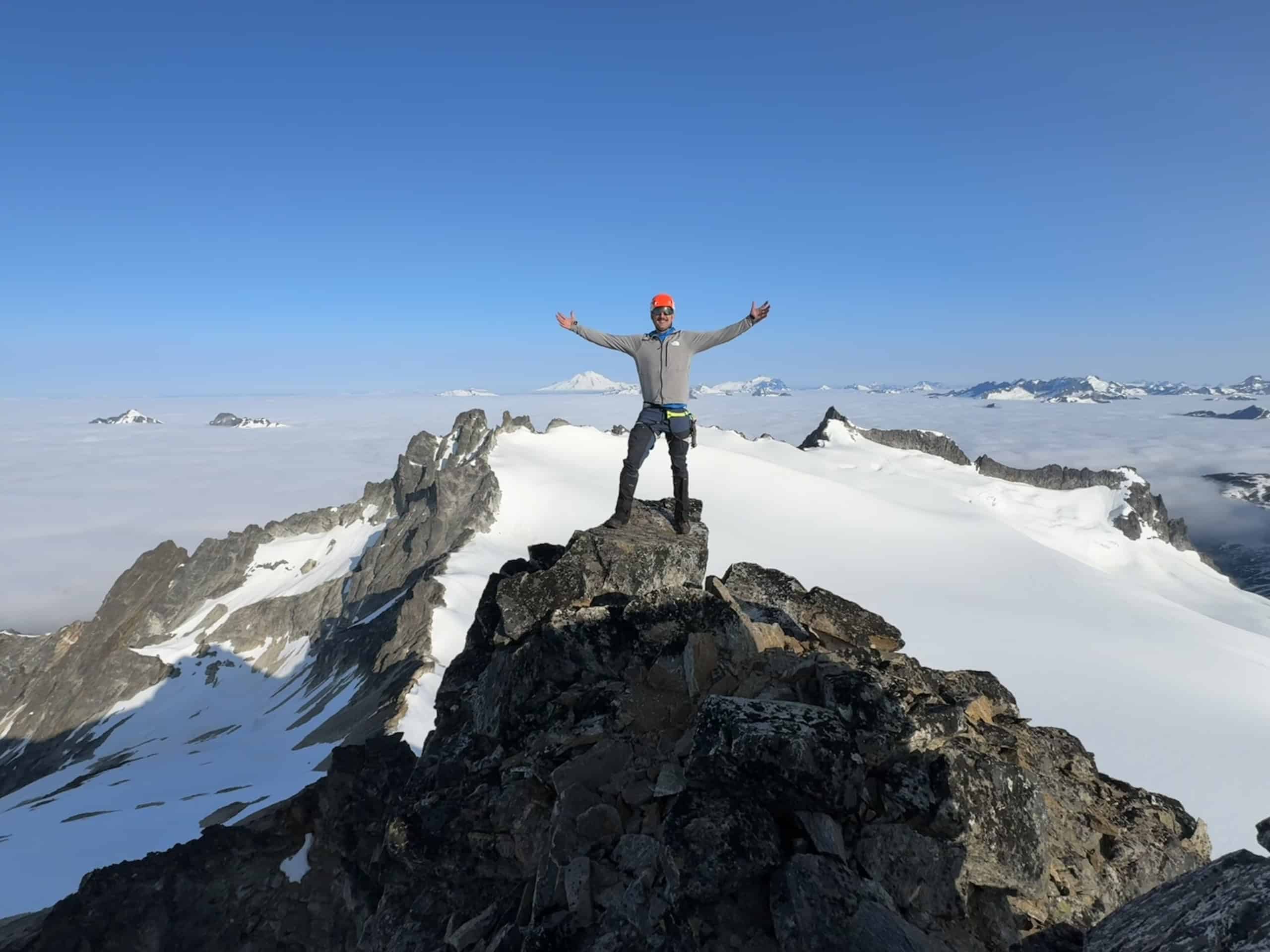
This idea that I can find the same feeling I have standing atop this mythical mountaintop as I have at home is something I only am recently beginning to understand. I live in a dense wood that blocks out the sun for most of the daylight hours. Yet in that shaded forest I’ve found a wilderness teeming with life: the patterns and habits of our local coyote family; the aviary bustle of barred owls, bald eagles, robins, and osprey; the patterns of the subterranean moles across the field; and the rabbits and squirrels that scavenge for food. In quiet moments, slowly walking or standing among the trees, I’ve found feelings that are in line with what Snyder calls “intimate contact with the real world.” I’ve had those same touches of clarity, though far rarer, on the street corners of downtown Seattle while I work as an EMT administering care to unhoused citizens who find shelter in tents. The kindness of a toothless smile, and all that an individual had to overcome in order to share that kindness, is a marvel I don’t quite know how to decipher. Could this practice of the wild that I partake of, out here in this rough and enlightening wilderness, be taken home to a way of life that can be practiced on the daily commutes and obligations of my habitual existence?
As the sun sets, I climb down toward my camp and rehydrate my freeze-dried dinner with cold water on the move, because the mosquitoes have not gone to sleep yet. I pull out my headlamp and place it on my sweaty forehead as the darkness makes following the path to camp that much harder. When I finally reach my tent, the night is black and smeared with the brilliant stars of the Milky Way.
In the morning I wake up to swarms of mosquitoes that assault the netting of my tent, waiting for me to exit and give them breakfast. As I watch the feral behavior of those insects, I eat an oatmeal bar and make a cold instant coffee. This is my moment of peace today, so I listen to the sound of water falling from the cliffs outside. I know that the moment I exit the tent it will be a mad dash to gather all my gear and crash down the mountain. In comedic fashion, I stumble through the act of packing up my camp and stuffing it in my backpack, as my skin gets bitten by hordes of insect mouths.
On my descent I realize that though I often come here for peace, I don’t always find it. Instead I find challenge, awareness of this often uncomfortable present moment, the feeling of being dangerously and vibrantly alive, even on the edge of mortality. I find callouses and blisters, rashes of bug bites, and bodily exhaustion. And in that catharsis I find release, acceptance, and gratefulness to be alive. I also find my limits, my faults, and more questions. On my way down, I don’t take the trash I pass for the second time. Exhausted, skin-flushed, drenched with two days of sweat, and covered in bite marks, I can’t gather the strength to pick up the damage others have left. It weighs on me as a moral failing, and I feel immense guilt because I had been so pompous in my thinking yesterday. As I rush down the mountain toward the raging creek, I think of all the trash I’ve walked past in my life, trash I just left there. When I get back to my car, I realize I had the strength and the time to take it with me. Next time, I reinforce within myself, I will be better. I will care more for things other than myself. For me, that’s the challenge of bigger issues like climate change; I need to care enough to make a change, to fix a problem that I might not have created but have been bequeathed because of the time and place I live in. This problem I’ve contributed to on a regular basis.

There’s so much that my time in the wilderness has taught and continues to teach me. It’s been an integral part of me finding a way through life as an openly gay man and has helped me overcome so many challenges. I want to share that with other queer people in hopes of showing them a way of life that’s given so many people throughout history a sense of meaning and connection.
Back home, I reach out to Moor and ask him for his thoughts on queer people’s relationship to nature. He writes back, “Queer people have a more difficult but potentially a more rewarding relationship with nature precisely because we are told from a young age that we are not natural. ‘Nature’ and the ‘natural’ are human concepts which are continually being redefined; we know this in our bones. This makes it easier for us to see how nature, too, is not as natural as it seems. Rather, it is deeply entangled with us. It creates us and we create it; it can heal us and we can heal it. And we have a lot of healing to do!”
A deep relationship to place can be a way out of our current climate crisis. For queer people, this relationship can offer a healing salve for the historical abuses inflicted upon us by societal structures and can promote a sense of purpose and connection in our existence here as a part of this environment. Snyder said that “self-realization, even enlightenment, is another aspect of our wildness,” and he conveyed the accessibility of this self-realization for all people when he said, “A person with a clear heart and open mind can experience the wilderness anywhere on earth.” We don’t have to trek to remote mountaintops to experience this; we can simply walk out our front door and into this wild world.
To share this concept of wilderness with those who have little or no access to it, to help them care deeply for and connect with the environment, is a tool that can be used to heal the earth and ourselves. For queer people who have historically been excluded or erased from the “natural” world, a reclamation of our inherent nature and place in the cycles of the earth can be entwined with the return to a balanced environment. We can replace centuries of abuse and extraction with stewardship, sustainability, and community for all living beings. The answers to our greatest challenges are in our nature. I hope you go out there and find them.
Photo credit (all images): Lance Garland
Excerpted and adapted from Out There: Dispatches from My Personal Wilderness by Lance Garland (October 2025). Published by Trinity University Press. All rights reserved. Published with permission from the publisher.
ABOUT THE BOOK
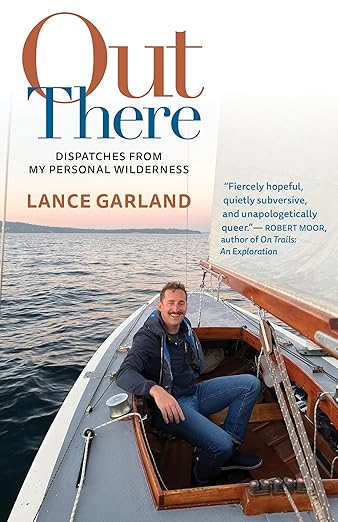 Out There recounts one man’s search to lead an authentic life, an adventure that takes him all over the world and through some of the biggest societal changes of recent history. From a distance, this could be a typical American story: boy grows up in a religious home, joins the military to defend his country, returns home to attend university, then becomes a firefighter. That would be typical if it weren’t for the fact that he’s gay and was open in places that historically excluded people like him.
As a nineteen-year-old from a fundamentalist family, Lance Garland worked hard to qualify for Navy SEAL training, then sailed across the Pacific on a warship where he met his first boyfriend. After his partner was sexually assaulted by a superior, the two men became witnesses in a court-martial that was complicated by the military’s “Don’t Ask, Don’t Tell” policy. After he was discharged from the Navy, Garland discovered time in nature as a way to heal from the experiences of his youth. While sailing, backpacking ,and climbing in the Pacific Northwest, he navigates the challenges of becoming a first-generation college student, equal rights activist, and the first openly gay fireman in the Seattle fire department.
Out There is a memoir of a man out in the wilderness, both physically and socially, on a journey to find a place to call his own.
ABOUT THE AUTHOR
 Lance Garland is a veteran, firefighter, nature adventurer, and writer. His work has appeared in Outside, Travel & Leisure, Backpacker, Orion, and elsewhere. His honors include the Pathfinder Prize, a fellowship at the Banff Center’s Mountain Writing Residency, and a Catalyst grant from the American Alpine Club. He lives on Bainbridge Island, Washington.