


Wildflowers of the West: Alpine & Subalpine Zones
Much of the alpine and subalpine West lies on federal lands—in national parks, wilderness areas, and national forests. The alpine zone is defined as the elevation above which no trees will grow. The subalpine is an intermediate zone between montane forests and the treeless alpine zone. Common trees of the subalpine include firs and Engelmann spruce, whitebark pine, and mountain hemlock. Floral wonderlands interrupt these forests of spare-looking and picturesque trees. In the Rockies of northern Idaho and northwestern Montana, the subalpine flora begins at about 6,000 to 6,500 feet, but in Colorado and northern Utah, at 9,000 to 10,500 feet. The subalpine zone is characterized by a very short growing season, nourished by a lot of precipitation that falls mostly as snow in winter, although rain is common in fall and spring. In the Pacific Northwest, wildflowers in this habitat are found in the Olympic Mountains and to both the east and the west along the Cascade crest. They are notably abundant on Hurricane Ridge in Olympic National Park, at Heather Meadows near Mount Baker, at Paradise and Sunrise at Mount Rainier National Park, and at Crater Lake in Oregon.
Some of the more spectacular species are glacier and avalanche lilies, blooming right beside melting snowbanks, plus Sitka valerian, paintbrush, bistort, lupines, and western pasqueflowers. Interestingly, spring comes later to the subalpine zone than the alpine zone: because the alpine zone is exposed to more wind and solar radiation, snow melts faster there than in the forested areas of the subalpine. In all the western mountain ranges at alpine elevations, the soils are very thin and rocky. Grasses and sedges grow there, but the soils are not rich, due to erosion from wind, water, and glaciation. Plants are forced to grow deep roots for nutrients and moisture and usually grow as small, cushion-like forms to protect themselves from the harsh winds; these tough survivors are often found in the lee of large rocks. On a hike from forest to subalpine to alpine, you will see marvelous adaptations of species—a lush lupine in the subalpine forest may give way to a tiny dwarf version in the harsh, tundra-like conditions of the alpine zone. Other common flowers are sedum, phlox, heather, and moss campion. I have not painted many of these because the flowers are very dainty, not well suited to block prints or watercolor.

In much of the Rockies, the elevation of the subalpine zone is much higher than in the Cascades: from 10,000 to 11,500 feet. This zone is heavily forested in the Rockies, so understory plants are sparse except for at forest edges and in clearings. Many flowers are found in the meadows and rivulets of this zone. Above where the forests give out at timberline, plant growth is very spare and tundra-like. On protected southern exposures, the tree line can go higher, and on cooler north-facing slopes, it can be less than 11,500 feet. Many of the plants are quite similar to those found in the subalpine and alpine zones of the Cascades and the Sierra Nevada, although there are some very striking endemics, such as the subalpine Colorado columbine, the state flower of Colorado.
In the Sierra Nevada, the altitude is similar to the Rockies, yet the climate is closer to that of the Cascades; a few of the most notable subalpine flowers are Lemmon’s paintbrush (named after Sarah Plummer Lemmon), mountain pride, and Sierra gentian. The Sierra subalpine zone may have almost six hundred species, two hundred of which are endemic. As in the other ranges, much of the flora includes plants that survived the glaciation of the last ice age. These so-called relict plants continued to thrive because they were on mountain peaks that stood above the ice, like islands.
As an artist, I’ve long been thrilled by one of the most wonderful aspects of subalpine flowers: their intensely saturated hues. The flowers are often also quite large, even on a small, or dwarf, plant, and many are fragrant. All of this is to ensure they’re a seductive presence for pollinating insects, as the plants are in a huge hurry to complete their seasons of growth and regeneration. Most of these flower displays occur in June, July, and August, when daylight hours are at their peak.
 Avalanche lily (Erythronium montanum, LILIACEAE)
The perennial avalanche lily is the first wildflower to bloom in high-elevation meadows in the Washington and Oregon Cascades, often in June or July, depending on altitude. The flowers appear in the melted-out areas of large snow patches, their delicate white petals in perfect harmony with the snow that surrounds them. The plant grows from 6 to 8 inches high and has shiny leaves, 4 to 8 inches long and half as wide. As the snowmelt accelerates, the lilies spangle entire meadows with their starry shapes, a scene I painted after a visit to Nisqually Vista at Mount Rainier National Park.
 Glacier lily (Erythronium grandiflorum, LILIACEAE)
The perennial glacier lily blooms very early as the snow melts, in June or July, depending on elevation. Look for it in high-altitude meadows throughout the West, from the Cascades into Montana, including in Yellowstone National Park and the Rockies. Similar in appearance to the avalanche lily, it can be distinguished by the bright yellow color of its starry petals. It grows from 6 to 12 inches tall, with shiny leaves 4 to 8 inches long and half as wide. Surprisingly, glacier lilies grow in the Columbia River Gorge at much lower elevations, where you can find them on wooded slopes, usually near oak trees, as far east as The Dalles, Oregon. In my garden, when possible, I grow nursery-bought plants that remind me of my favorite wild species, since they recall wildflower-hunting adventures and hikes over many years. In late March, an Erythronium relative called the pagoda lily leafs out and blooms, one of the earliest spectacles in my backyard. Dozens of yellow lilies sparkle atop a bright green mound of lush foliage.
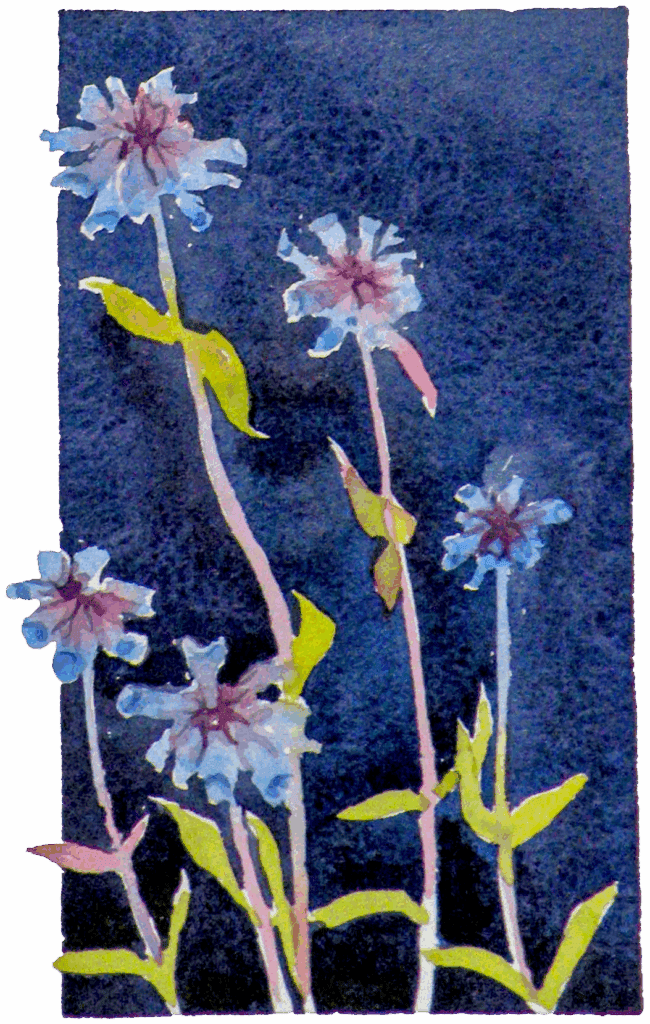 Small-flowered penstemon (Penstemon procerus, SCROPHULARIACEAE)
The small-flowered penstemon is a widespread perennial that grows from mid- to high elevations. It can be found as far north as Alaska, south into the Sierra Nevada, and east to the Rocky Mountains in Colorado. Like many penstemons, it prefers rocky slopes, so it is readily found in subalpine habitats. Its species name, procerus, is a bit of a misnomer because it means “high” or “tall,” whereas this plant is short, only 2 to 12 inches tall. Dee Strickler, penstemon expert, has speculated that the name references its high-altitude habitat. The leaves are thin and lance-shaped and point upward. The tubular flowers grow in tight clusters around the stem, almost forming a ball shape. They are deep blue in color, tinted rose along the outside of the tube, and with a white throat. The flowering time depends on altitude but can occur anytime from May to August. I’ve seen it on Mount Rainier in August. I painted this penstemon with watercolor, creating a dramatic dark background to set off the delicate blues and violets of the flowers, a technique I used often in illustrating the flowers in this book.
Cascade aster (Aster ledophyllus, ASTERACEAE)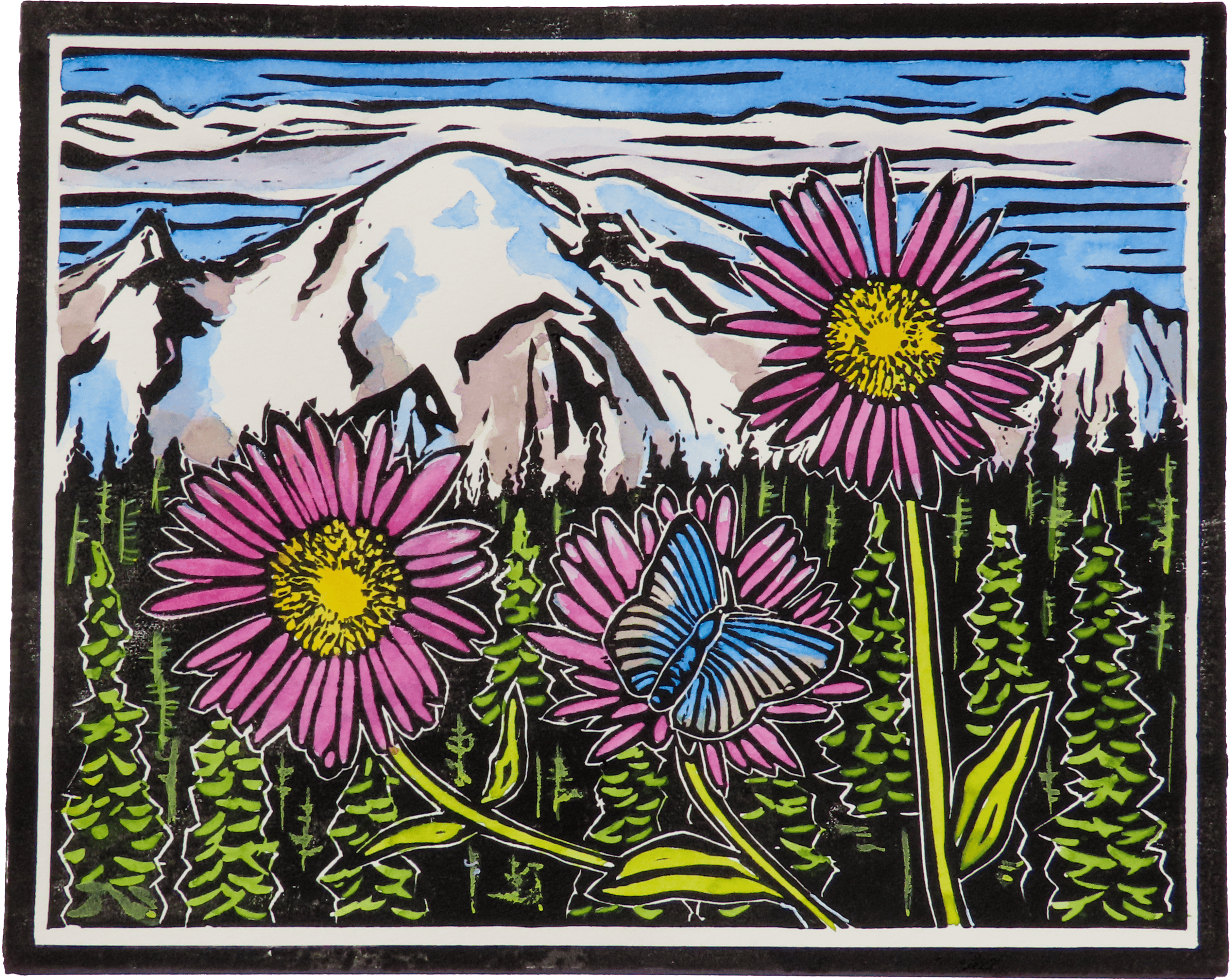 Asters are very common late-summer ray-and-disk-type perennials that grow at elevations from 4,000 to 6,500 feet, in meadows and on rocky slopes in the Cascades of Washington, Oregon, and Northern California. The stems are up to 3 feet tall, and elliptical leaves with shiny upper surfaces and hairy undersides emerge from the hairy stems, all growing from a woody base. The lower leaves are smaller, with the middle and upper leaves equal in length. The daisy-like flowers consist of up to twenty-one rays emanating from a central yellow-orange disk. Colors range from pink to pinkish-violet to blue. The flowers attract many pollinators, including the fritillary and the alpine blue butterfly, as I’ve observed along the trail at Sunrise in Mount Rainier National Park.

On a September visit, the only flowers remaining were gentians and asters. I loved the visual drama and strong values contrast of the aster, the butterfly, and the white snow of Rainier. Fritillaries and bees were desperately seeking pollen, and they reminded me of the human visitors on this sunny fall day, all of us grasping at our last chance for sunshine before the rains came.

Alpine harsh paintbrush (Castilleja hispida, SCROPHULARIACEAE)The perennial harsh paintbrush, with its distinctive scarlet hues, grows at elevations from 1,000 to 5,000 feet and blooms from mid-spring to midsummer. It’s common in grassy meadows and forest fringes in Washington and Oregon, both west and east of the Cascades. The stems are 8 to 24 inches tall, with small lower leaves; the upper leaves develop five to seven lobes. The bracts and some upper leaves carry the color, which can be red, orange, or even yellow, attracting pollinators and hummingbirds. Paintbrushes are hemiparasites, gathering nutrients from the roots of other plants. The woodblock print pictures a northwestern fritillary visiting a blooming plant near Washington Pass in the North Cascades. I imagined this meeting of pollinator and flower, finding in their hues a likely compatibility—the ochres, golds, and rust tints of the Golden Horn granite batholith, the seductive scarlet paintbrush, and the sienna butterfly.
Mountain pride (Penstemon newberryi, SCROPHULARIACEAE)
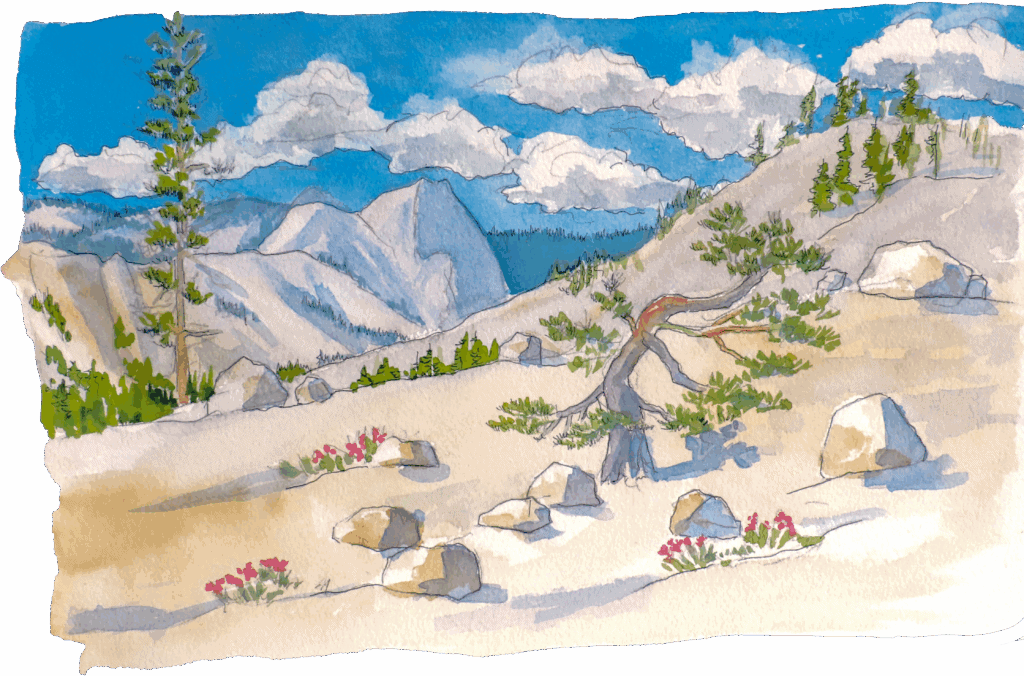 This aptly named perennial penstemon, flowering in midsummer—and incidentally, John Muir’s favorite flower—grows in southernmost Oregon and in California, in the northern coast ranges, the Cascades, and the Sierra Nevada. Its preferred habitat is rocky slopes and cliffs from 2,000 to 11,500 feet. It is quite shrubby but grows no taller than 12 inches, with a woody base and flower stems carrying basal, lance-shaped evergreen leaves. Narrow, tubular, two-lipped flowers, 1 to 11/2 inches long, are clustered at the top of each stem in hues from cherry red to violet-rose.
A trip up the Tioga Road with my students from Yosemite Conservancy was a highlight of the class I taught there one June. We walked a short distance up the granite slabs from Olmsted Point and were astonished at the variety of flowers blooming. It was not only the marvelous views but also the plant life growing right out of the cracks in the rocks that made this one of the most precious adventures I’ve ever had. I made a watercolor sketch on-site, and later, back in the studio, I felt that it needed more definition, so I added some pen lines.
Shrubby cinquefoil (Potentilla fruticosa, ROSACEAE)
 The perennial shrubby cinquefoil, also known as Dasiphora floribunda, is common in the western Washington Cascades as well as in eastern Oregon. A related plant, the fan-leaf cinquefoil, grows in the California Cascades and the Sierra Nevada. This 2-to-4-foot-tall woody shrub has tiny oval leaves less than 1 inch long. One or more yellow flowers grow at the end of each twig, with five or more petals surrounding a central disk. Masses of the flowery shrubs make an impressive display at Mount Rainier National Park in late summer, although it can bloom all summer long in the lower elevations of its range—it is found from 5,000 to 11,000 feet, depending on latitude. I painted this watercolor view of imposing Mount Rainier with cheerful cinquefoil flowering in the foreground from the Wonderland Trail near Berkeley Park. Cinquefoil is a popular garden plant, and I grow it in my backyard, where it blooms from July until frost.
Sitka valerian (Valeriana sitchensis, VALERIANACEAE)
 The perennial Sitka valerian is a delicate midsummer wildflower found in moist subalpine meadows, usually in airy white masses that give the meadows a feeling of purity and freshness. They are happiest in wet places, and I’ve seen them in the North Cascades at Stevens Pass, in the central Cascades, and most impressively, perhaps, at Mount Rainier National Park, where they filled an entire forest opening, growing upright even though the meadow took a dizzying 45-degree descent. The plants can grow up to 4 feet tall, with sturdy stems and leaves that are lobed or coarsely toothed. The compact flower heads are composed of many tiny flowers.
I painted this watercolor by sketching in the general shapes of the flowers, wetting the entire paper except the whites of the flowers, and then laying in various washes of green. I worked in stages, with the darker greens added last. The white flowers, seen as positive space, were defined by the negative space of green that surrounded them.
From my journal:
The meadows at Stevens Pass shelter a rich collection of wildflowers throughout the summer—a surprising and fortunate consequence of the deforestation that accompanied the development of the ski resort there. I hiked at the pass, on the Pacific Crest Trail, on an overcast day in early July just before mountain biking season got under way. There were few travelers since it was far too early for the PCT hikers, who show up in August and September after hiking northward from the Sierra and southern Cascades. Without a doubt it is a locale of compromised beauty, with the sprawling ski area and its array of chairs, bull wheels, poles, and cables; who wants a selfie in front of a disused ski area in summertime?
In any other year I would have postponed the outing, thinking that without sun there would be few pollinators, colors might be subdued, I could be cold, and the gloom could be overwhelming, as it often is high in the mountains with fog wreathing dark hemlocks and gray talus slopes. But because of family illness it had been months since I’d gone up to the mountains, and I missed them sorely. Also, prime summer hiking season has been shortened lately by wildfire season, which now may begin in June and last through September. I told myself it’s now or never.
In the open forest just above the parking lot, Sitka valerian was blooming, with its tall stalks and airy sprays, and as the way opened to full light, there were luxurious drifts of them everywhere on each side of the trail. Just around the corner on open, sunbathed slopes, hundreds of lupine grew in startling diagonals. Next, I saw mountain asters, and then a small collection of columbine, beloved flower of hummingbirds. I photographed one bloom that was dramatically staged with a backdrop of white granite. Somehow everything was even more beautiful in the soft gray light, all of it a joyful reclaiming of everything that I have loved most in my life.
Colorado columbine (Aquilegia coerulea, RANUNCULACEAE)
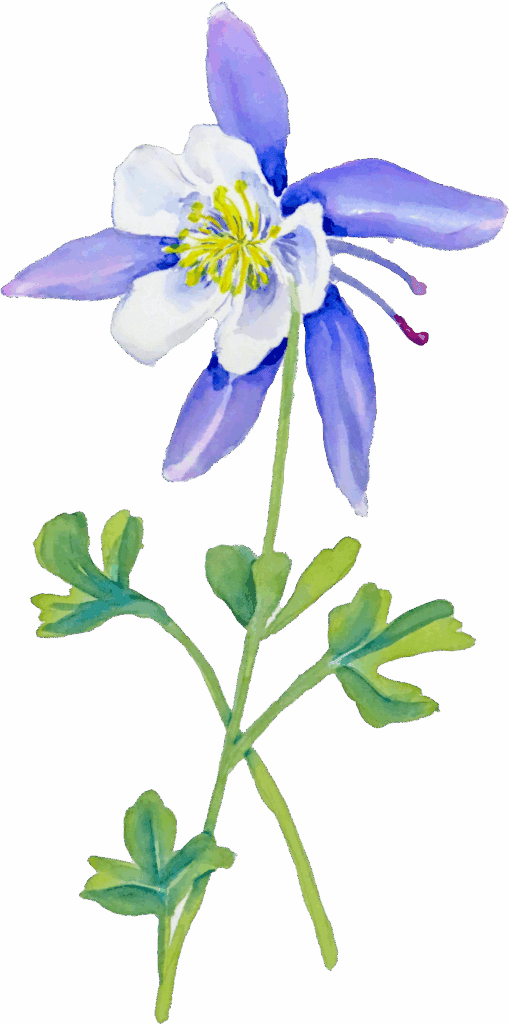 The perennial Colorado columbine deserves its designation as the state’s official flower, with spectacular blooms up to 3 inches across. The five sepals are blue to lavender, with five scoop-shaped white petals that trail blue spurs. Yellow stamens decorate the inner base of the flowers. The plant can grow up to 3 feet tall and has mostly basal leaves, bluish green underneath and with rounded lobes. This columbine is most commonly found in the moist soil of willow thickets, aspen groves, and forest openings in Idaho, Montana, New Mexico, South Dakota, Utah, and Wyoming, as well as in its namesake Colorado. Bloom time is June to August. I painted the flower without a background, allowing its stunning shape and color to speak for itself.
Western pasqueflower (Pulsatilla occidentalis, RANUNCULACEAE)
At Mount Rainier National Park, the perennial western pasqueflower, also known as the western anemone, appears from early June through autumn in all stages of growth. You may see the pristine 1-to-2-inch white flowers near a recently melted patch of snow in a shaded area, or perhaps you’ll encounter an entire sunny meadow that melted out quite early brimming with the curious seedheads, which follow the briefly blooming flowers and can last up to two months. The seeds are attached to countless silky filaments that look like hair. As the plant ages further, the filaments fly away with the seeds attached, so it’s no wonder meadows are full of them. In his classic book A Year in Paradise, Floyd Schmoe, an early Rainier park ranger, Quaker activist, and naturalist, describes them as “troops of little gray monkeys.” Other names include moptop, towhead baby, and old man of the mountain. The nineteenth-century Washington botanist C. V. Piper wrote that the anemone “always excites attention, their plumed heads reminding one irresistibly of the caps worn by grenadiers.”
Just outside the Sunrise Visitor Center, on the northeast side of the park, there is a display of wildflowers with signs identifying them. The pasqueflower seedhead is probably the most striking of all. I first noticed the display many years ago on a brief stop at the center after a hike. That small but meaningful Park Service education encouraged me (and, no doubt, many others) to begin recording, photographing, and painting all the flowering marvels I saw on my hikes and adventures. I hope this book spurs you to do the same.
Explorer’s gentian (Gentiana calycosa, GENTIANACEAE)
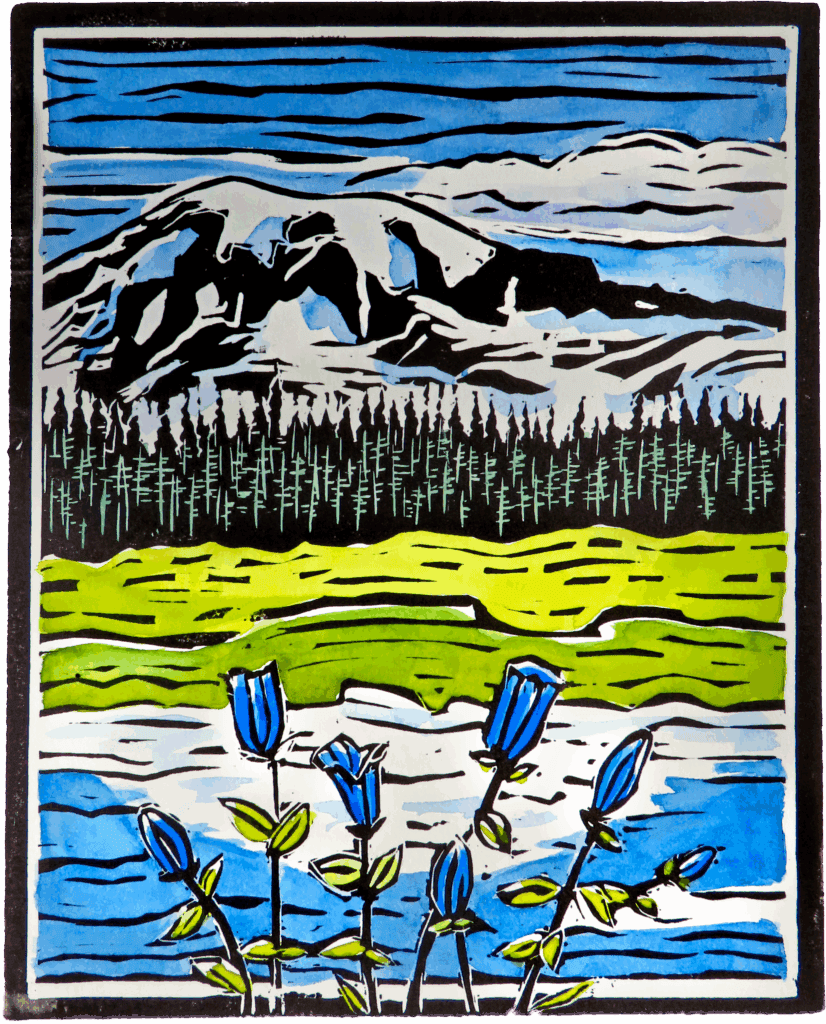 This perennial, also known as bog gentian, is one of the most beautiful plants of the wet alpine habitat and is more deeply appreciated because it is a late flower, seen in early autumn. The plant is 8 to 20 inches tall, sometimes growing prostrate, with round or egg-shaped green leaves. The elegant blooms, deep blue in color, face upward in the form of bells.
On a September day in Mount Rainier National Park, I encountered the most spectacular group of gentians I’ve ever seen, growing very close to the lower Sluiskin Falls of the Paradise River. The gentians were thriving in that moist location, creating a luxurious splash of blue-violet, a color like the zenith of Rainier’s sky. I created both a block print and a pen and watercolor sketch of the gentians. For the block print, I decided to position the flowers on the edge of one of the Reflection Lakes, a few miles southeast of Paradise (see the “Mount Rainier National Park” sidebar, page 128). I so identify the flowers with Rainier that I wanted to show them in this much-photographed location, where the mountain is mirrored in the lake, surrounded by moist subalpine meadows. In the sketch, my goal was simply to reproduce the profusion of flowers.
Excerpted and adapted from Wildflowers of the West: An Artist’s Guide by Molly Hashimoto (September 2025). Published by Skipstone, an imprint of Mountaineers Books. All rights reserved. Used with permission from the publisher.
About the book:
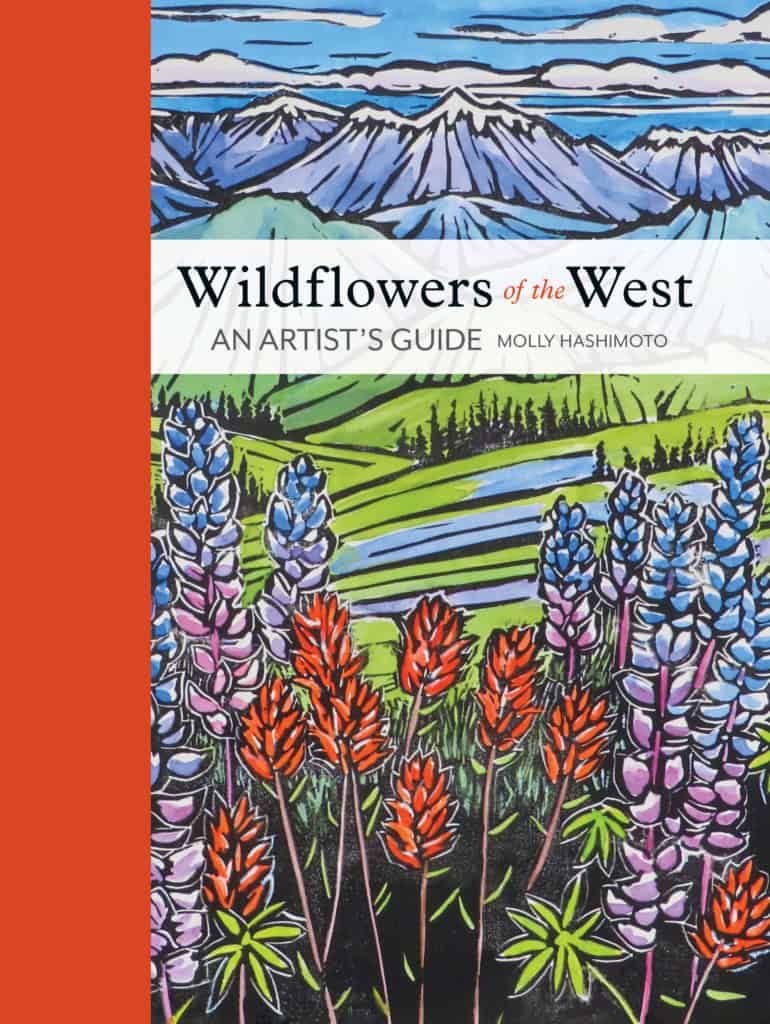 Bestselling artist Molly Hashimoto brings her unique blend of vibrant illustration, engaging natural history, and intimate personal reflection to the Western landscape–this time exploring the ephemeral beauty of wildflowers. Organized by habitat, Wildflowers of the West showcases flora from wetlands, shorelines, and prairies to deserts, forests, and alpine meadows.
Accompanying each piece with natural history and stories of her own outings to find flowers, Hashimoto captures individual species through different media, from quick sketches with pen and ink to detailed watercolors and carefully planned block prints. Find exquisite golden columbines emerging from talus slopes, vast meadows of sky-blue lupine, scarlet displays of ocotillo in the southwestern deserts, and sunny blooms of glacier lilies as they herald the approach of spring. Weaving in the history of wildflowers in art along with sidebars offering practical techniques for artists, Wildflowers of the West is an inspiration for anyone who would like to try their hand at capturing the delicate beauty of wildflowers they encounter or simply an armchair album for those who appreciate the natural beauty of the American West.
About the author:
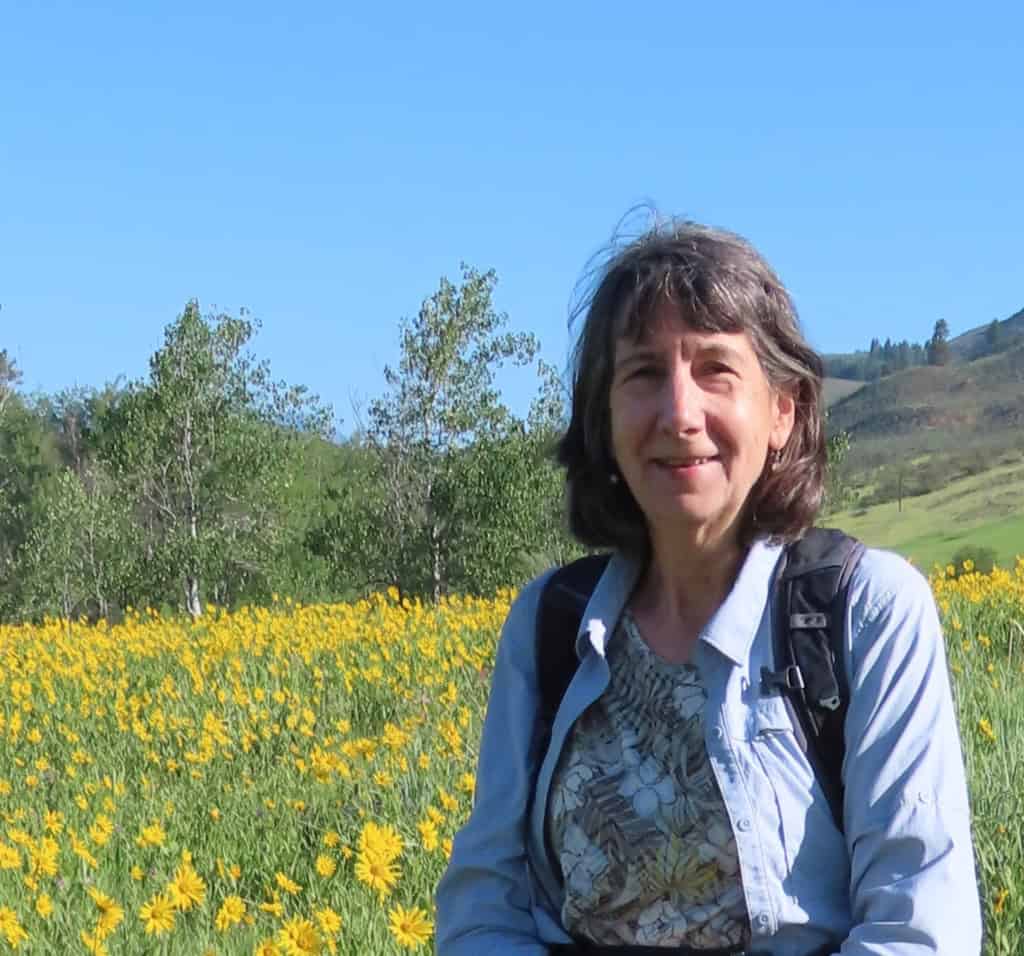 MOLLY HASHIMOTO teaches and leads plein air watercolor painting and printmaking workshops around the West, including at the North Cascades Institute, Yosemite Conservancy, Winslow Art Center, and Sitka Center for Art and Ecology. The author of four books including Trees of the West and Birds of the West, she lives in Seattle. Learn more at mollyhashimoto.com.